Bulk solids valves serve a critical function in industrial processes that convey, discharge, isolate, meter, or divert dry materials.
Although they may appear to be secondary components compared to a plant’s main machinery, their performance directly affects operational continuity, product quality, personnel safety, and maintenance costs.
In a solids handling line, a valve is not merely a pass-through element. It is the control point for material movement, where improper selection can cause problems well known to many plants: product leakage, fugitive dust, cross-contamination, incorrect silo filling, clogging, accelerated wear, repetitive maintenance, and safety risks for personnel servicing the equipment.
These difficulties can arise in industries such as food, animal feed, cement, dry chemicals, plastics, fertilizers, minerals, grains, flours, sugar, and other operations handling raw materials in bulk.
The challenge involves much more than simply opening or closing a gate. Every material behaves differently depending on its particle size distribution, flowability, abrasiveness, moisture content, compaction, friability, temperature, conveying pressure, and contamination sensitivity.
For this reason, selecting valves for bulk solids should not begin solely with a question about line diameter or discharge dimensions. It must start with a comprehensive evaluation of the material, the process, and actual operating conditions.
Why Is the Selection of Bulk Solids Valves Critical?
Two materials flowing through a pipe of the exact same diameter may require entirely different valves. A fine, cohesive powder does not behave like a pellet, a plastic granule, an abrasive aggregate, or a contamination-sensitive food product.
Before selecting a valve, it is necessary to understand what the equipment must accomplish, how the material behaves, and what conditions it will be exposed to during operation.
Material Characteristics
The first step consists of analyzing the product passing through the valve:
These characteristics determine the flow passage geometry, materials of construction, sealing system, and actuation type that will function best.
Process Conditions
It is also necessary to analyze how the material moves through the plant:
A valve used in a gravity discharge application will not necessarily withstand the demands of a pneumatic line subject to differential pressure, high temperatures, or abrasive materials.
Quality and Hygiene Requirements
In sectors such as food, ingredients, chemicals, and plastics, the analysis must also consider product quality aspects:
In the food industry, these criteria must integrate with hazard control systems and established measures to protect food safety during receiving, processing, and packaging.
Plant Operational History
Finally, it is necessary to review current field conditions:
Observing field equipment helps identify whether a problem stems from the valve itself, improper selection, installation conditions, or material behavior.

Technical Selection Must Also Quantify the Problem
A thorough evaluation of bulk solids valves goes beyond identifying a failure—it must establish its true impact on operations.
To do so, it is useful to address questions such as:
When these variables are backed by plant data, the conversation changes. The valve is no longer viewed as an isolated purchase, but as a critical point of reliability, productivity, quality, and total cost of ownership (TCO).
The Real Cost of Bulk Solids Valves Is Not Just the Purchase Price
When a valve begins to present issues—such as gate binding, loss of seal integrity, premature failure, plant shutdowns, or material leakage—a common reaction is to seek a lower-cost alternative, copy the existing design, fabricate it locally, or adapt a spare part available in the maintenance shop.
This practice is not inherently negative. Many plant maintenance teams have strong mechanical capabilities and can respond quickly to emergencies. The problem arises when the solution focuses on replicating the external shape of the valve without addressing the root causes of the failure.
In bulk material handling, real cost must be evaluated by considering:
An inexpensive valve that jams, leaks, or contaminates product is not a low-cost solution.
Dust-Tight Sealing in Bulk Solids Valves
In bulk solids handling, sealing does not depend solely on a gate reaching its fully closed position. It also depends on the design of the contact area between the blade, body, seals, and the material moving through the equipment.
A valve may appear visually closed while continuing to cause operational issues if material migrates into the seals, internal cavities accumulate fines, or geometry allows product to enter a port that should remain isolated.
These conditions can lead to:
Dust-tight sealing must be addressed during the selection stage rather than as an aftermarket add-on. In bulk solids valves, it forms a central pillar of equipment engineering.
Solutions engineered by Vortex, a strategic partner of Caproin, are developed specifically to handle dry bulk materials. Their designs keep product within the process stream, protect sealing surfaces, eliminate dead zones, and facilitate in-line maintenance without requiring major teardowns.
Cross-Contamination: A Failure That Is Not Always Visible
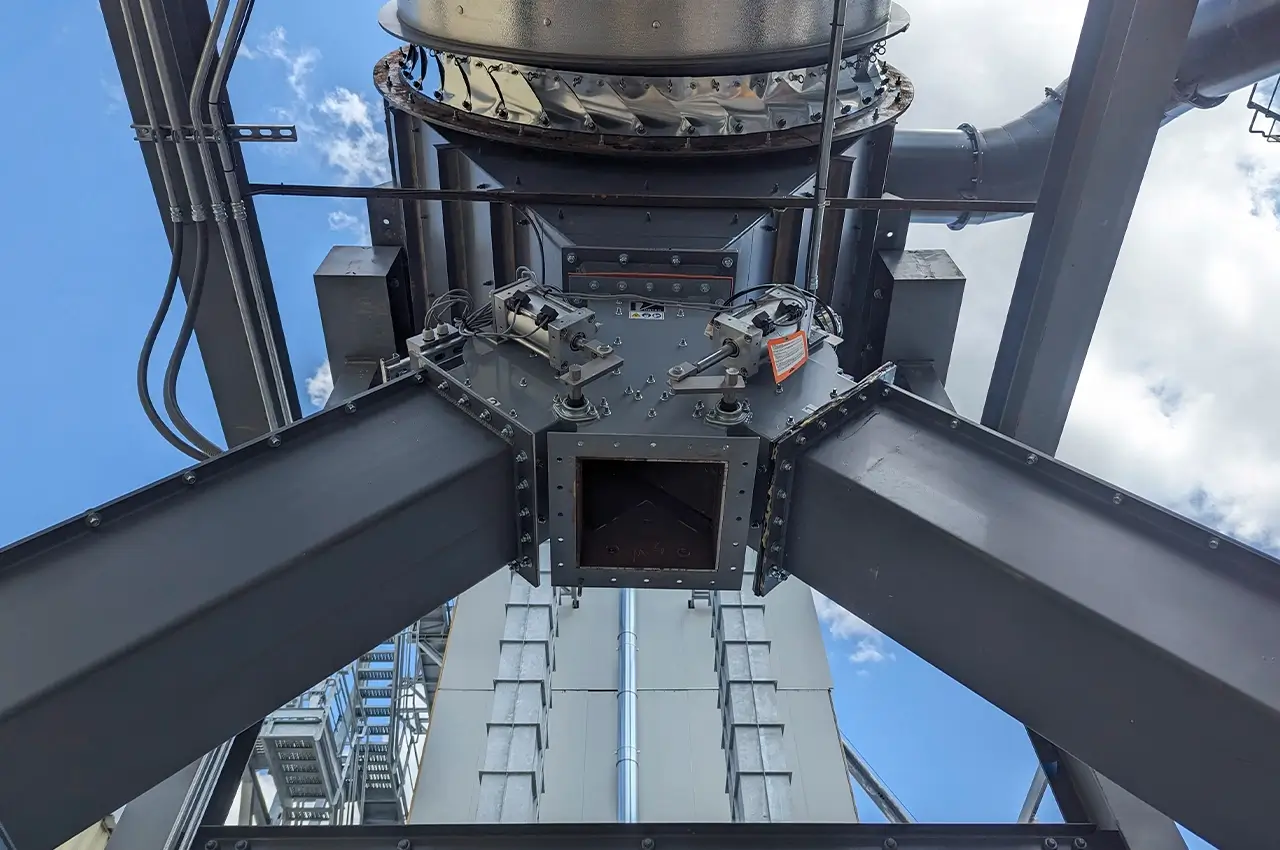
In systems where a single line feeds multiple silos, hoppers, mixers, or destinations, a diverter valve carries two responsibilities: directing product to the correct destination and preventing residual particles from migrating into closed ports.
When a diverter fails to seal positively, material can collect in internal pockets or bleed into an isolated line. The problem does not always manifest as an immediate mechanical failure.
In many cases, it appears downstream as:
This risk is particularly critical in food, ingredients, animal feed, chemicals, plastics, and specialty raw materials.
In these applications, valve design, seal type, flow passage geometry, and self-cleaning action are just as critical as actuation type or material of construction.
Clogging: When Reliability Becomes a Safety Issue
When a valve jams, the impact extends beyond production downtime.
In some facilities, operators must manually clear packed material. This can expose personnel to a jammed blade, a head of material, a energized actuator, or residual line pressure.
If the material mass releases suddenly, it can cause abrupt movement, strike workers, create pinch points, or cause an unexpected discharge.
For this reason, bulk solids valves should not be evaluated solely on nominal open/close capabilities. They must also be analyzed regarding:
The lower a valve’s tendency to bind, the lower the exposure of plant personnel to safety hazards and unexpected outages.
Combustible Dust: A Variable That Cannot Be Ignored
In specific industries, dust is not merely a housekeeping issue. Finely divided particulate matter can create a deflagration or explosion hazard when suspended in air in the presence of an ignition source.
Materials capable of generating combustible dust include sugar, flour, starches, grains, animal feed, spices, plastics, coal, dry chemicals, and certain metallic powders.
This does not imply that every application requires identical precautions. It means system design must account for:
A valve that continuously permits fugitive dust increases cleaning frequency, causes product loss, and contributes to hazardous dust accumulations around the process area.
Not All Valves Are Suited for All Bulk Solids
One of the most frequent causes of field failure is selecting a valve based on familiarity, availability, or upfront price rather than compatibility with the material handled.
For instance, butterfly valves are widely utilized across general industrial processes. However, in dry bulk applications, the internal disc remains directly in the material stream, which can:
Conventional knife gate valves can also present operational challenges if their seals are directly exposed to material or if internal cavities allow product to compact, spoil, or impede complete stroke travel.
This does not render these valve types unsuitable for all duties; rather, it underscores that their application must be carefully evaluated. In bulk solids handling, selection must be driven by product behavior and system parameters, not just port dimensions.
Types of Bulk Solids Valves by Application
The Vortex portfolio includes solutions developed for varying flow conditions, diverting requirements, pressures, abrasion levels, and maintenance needs.
Choosing between a diverter valve, a gravity flow slide gate, or a valve engineered for pressurized lines depends on a technical diagnostic of the application.
Wye Line Diverter: Diverting Material Without Compromising the Line
In pneumatic conveying, a diverter valve must do more than change flow direction—it must maintain system pressure, prevent cross-contamination into closed ports, and eliminate areas where material can lodge.
The
Vortex Wye Line Diverter is engineered to divert or converge dry bulk solids, primarily in high-frequency applications related to storage filling and transfer.
Its full-bore machined orifice allows unrestricted material movement, maintaining conveying pressure while minimizing bridging, plugging, or flow interruptions.
Key features include:
In lines feeding multiple silos or mixers, these design traits are critical. If the diverter leaks into an inactive port, cross-contamination occurs. If it causes pressure loss, pneumatic system capacity drops. If it retains material, subsequent batches are compromised.
The Wye Line Diverter can be configured for pressure or vacuum applications, handling powders, pellets, and non-to-moderately abrasive granules depending on valve sizing and options.
Roller Gate: Reliable Isolation in Gravity Discharge
In gravity-fed discharge from silos, hoppers, mixers, weigh hoppers, and screw conveyors, the isolation valve must stop material flow without leaking or demanding constant maintenance.
The Vortex Roller Gate is designed primarily for dry materials in gravity flow. It handles powders, pellets, granules, and non-to-moderately abrasive fine materials.
The valve features wear-compensating seals designed to maintain continuous contact with the blade as normal operational wear occurs. Both side seals and bonnet seals can be inspected or replaced while the valve remains in service.
Key features include:
These characteristics make it an effective isolation element where reliable shut-off is essential for process control.
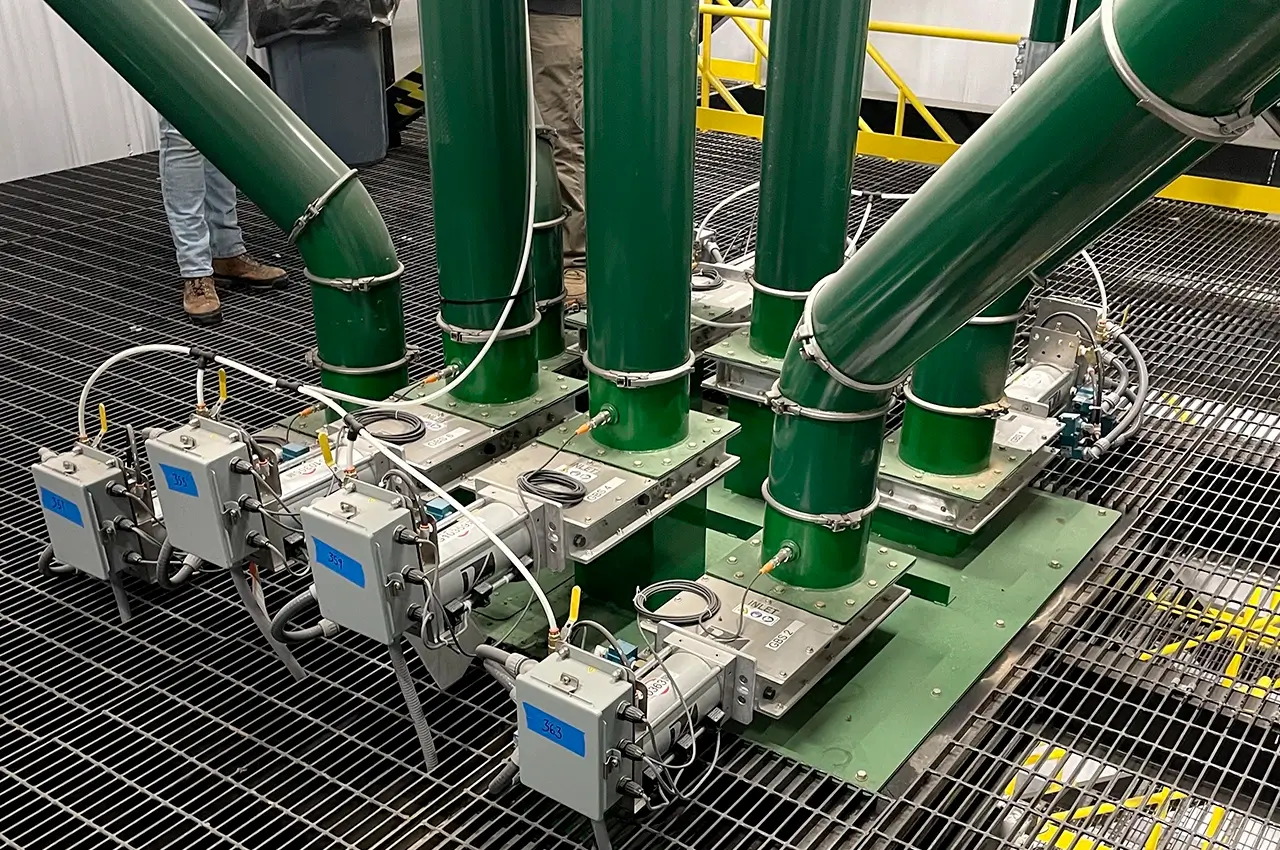
In a fine sugar handling application, three Roller Gates were integrated into a compact diverter assembly. This solution enabled multi-destination feeding, dust control, and compliance with tight plant headroom constraints.
Titan Pressure Valve: Pressure, Temperature, and Abrasion
In applications involving cement, minerals, lime, fly ash, sand, coal, cullet, and other highly abrasive materials, operating conditions are severely demanding.
In these processes, bulk solids valves must withstand:
The Vortex Titan Pressure Valve is engineered for abrasive dry materials operating under higher pressures or temperatures.
Its blade closes against a fixed stop seat, utilizing spring-loaded guides to maintain positive closure. The leading edge of the blade is beveled to displace material and prevent packing at the seat.
Additional engineering highlights include:
Depending on configuration and size, it can be deployed in gravity flow, dilute phase, dense phase, pressure, or vacuum systems.
In a cement facility application documented by Vortex, two Titan Pressure Valves were specified for pneumatic lines connecting to a truck loading station, ensuring reliable cement sealing and long-term abrasion resistance.
Orifice Gate: Engineered Specifically for Dry Bulk Solids
The Vortex Orifice Gate was developed specifically for dry bulk material handling across gravity flow, dilute phase pneumatic conveying, and vacuum systems.
Its full-bore straight-through design maintains a clear flow path when open. This shields internal components from direct material impingement and eliminates flow restrictions common in traditional valve designs.
Features of the Orifice Gate include:
It handles non-to-moderately abrasive powders, pellets, and granules, with modifications available for corrosive materials or washdown environments.
Where reliable shut-off, dust containment, and ease of maintenance are paramount, these features offer significant operational advantages over non-specialized general service valves.
Bulk Solids Valves in the Food Industry
In food processing, a valve must control material flow without compromising hygiene, product quality, or traceability.
Ingredients such as coffee, sugar, flour, grains, and nutritional powders present distinct challenges:
In these applications, internal valve geometry and seal protection are critical. Cavities where material collects can become sources of microbial growth or batch-to-batch contamination.
Coffee Handling
Roasting and processing facilities require moving green and roasted coffee between storage silos, roasters, weigh hoppers, and packaging lines while maintaining bean integrity and preventing residue buildup.
In a documented installation for a U.S. coffee manufacturer, Vortex valves were deployed at multiple process points to regulate material movement.
Another coffee roasting plant installation demonstrated the necessity of evaluating transfer dynamics, space limitations, washdown needs, and seal integrity.
Selecting valves for these duties requires analyzing product friability, cycle frequency, materials of construction, and in-line maintenance capabilities to prevent costly downtime.
Fine Sugar Handling
Fine sugar can migrate through minimal tolerances, build up around seals, and generate fine dust if the valve design is inadequate.
In France, a processing plant implemented Roller Gates to divert fine sugar to multiple destinations. The valve package met strict dust-tight sealing requirements within restricted overhead clearance.
In sugar applications, closure must be evaluated not only by blade position, but by the valve’s capability to contain product, prevent residue accumulation, and facilitate effective sanitation.
To complement product purity, evaluating tramp metal contamination through magnetic separation and detection systems is also recommended.
Bulk Solids Valves in the Cement Industry
Cement, sand, lime, fly ash, and slag subject valves to severe abrasion, high differential pressures, and elevated temperatures.
Under these conditions, an improperly specified valve quickly leads to:
Selection must consider material type, conveying velocity, transfer method, differential pressure, temperature, and valve location within the system.
Vortex’s technical article on valves for cement handling explains how abrasion, high temperatures, and conveying pressures dictate equipment design.
In dense phase applications, for example, material can move at lower velocities in slugs separated by air. In dilute phase, higher conveying velocities can increase wear on piping, seals, and components.
There are also diverting applications in concrete manufacturing. A case study featuring a 3-way Titan Lined Diverter demonstrates the handling of sand and aggregates used in concrete production.
For these conditions, simply installing a heavy-duty gate is not enough. It requires selecting wear-resistant materials, protecting sealing areas, and evaluating how the equipment will perform under pressure and abrasive flow.
Bulk Solids Valves in the Plastics Industry
Handling plastic resins, pellets, powders, and regrind presents challenges involving abrasion, static electricity, product degradation (e.g., streamer formation), material packing, and color/grade cross-contamination.
In pneumatic lines feeding multiple silos or blenders, diverters must maintain system pressure while preventing cross-bleeding into closed legs.
A documented Wye Line Diverter application handling plastic regrind demonstrates straight-through diverting of recovered materials from storage silos. The sealing system eliminated cross-contamination between resin colors while enabling quick in-line serviceability.
When handling recycled regrind, custom engineering is particularly important due to wide variations in particle geometry, edge sharpness, and bulk density.
How to Select Valves for Bulk Solids
A proper technical evaluation requires reviewing the complete process system rather than evaluating the installation point in isolation.
The evaluation matrix should cover:
Caproin provides a portfolio of industrial products and engineering solutions tailored for dry material handling. However, final equipment specification must always be driven by specific application data rather than generic standard part numbers.
The Question Is Not Simply What the Valve Costs
Each of these failure modes carries direct financial consequences regarding productivity, safety, and operational costs.
Therefore, the primary question should not be: What is the purchase price of the valve?
The correct question is:
What is the total operational cost of continuing to run a valve that fails to control bulk solids flow?
Conclusion: Controlling Flow Means Protecting the Operation
Bulk solids valves should not be evaluated solely by their ability to open or close. They must be analyzed for their capacity to control material flow, contain dust, resist wear, prevent accumulations, protect product quality, and minimize manual intervention.
In some cases, a locally fabricated solution may function adequately. However, when the application demands dust containment, differential pressure, reliable diverting, sanitary conditions, abrasion resistance, or operational safety, replicating a valve without proper application engineering can result in costs that far exceed the initial savings.
A plant’s reliability does not depend solely on its primary equipment. It also depends on these control points that define how the process flows, remains protected, and stays stable.
At Caproin, we support industrial operations in the technical selection of bulk solids valves and other material handling and conveying solutions, combining our field expertise with specialized manufacturers like Vortex.
Every application is evaluated based on its operational reality: material properties, flow, pressure, abrasion, product safety, maintenance, safety, and process continuity.
Because when flow is controlled correctly, the plant operates with greater reliability.
Need to Select a Bulk Solids Valve?
Every application is unique. Before choosing a valve, our team can help you analyze your material, conveying system, leak points, contamination risks, and maintenance needs.
Contact a Caproin specialist and let’s discuss your process requirements.